Aerospace Engineering

Analysis of impact resistance of polyurethane reinforced honeycomb core sandwich structure

  • Xiaoqiang WANG ,
  • Jing GUO ,
  • Wenbo ZHANG
Expand
  • College of Aerospace Engineering,Shenyang Aerospace University,Shenyang 110136,China

Received date: 2025-01-14

  Revised date: 2025-04-10

  Accepted date: 2025-04-15

  Online published: 2026-06-15

Abstract

To investigate the effect of polyurethane coating on the impact resistance of honeycomb sandwich structures, the impact response of composite sandwich structures with polyurethane coating applied to the inner walls of honeycomb cores under low-velocity impact conditions was analyzed.Based on the validated numerical model, a numerical analysis was performed to examine the low-velocity impact behavior of composite sandwich panels with varying coating thicknesses. Multiple indicators were employed to analyze the influence of coating thickness on the impact resistance of the composite sandwich panels. The results indicate that the honeycomb sandwich structure with a 0.5 mm thick coating on the inner walls exhibits an 11.11% reduction in the honeycomb core indentation depth and an 11.98% decrease in the indentation diameter along the impact direction. This method effectively enhances the impact resistance of honeycomb sandwich structures.

Cite this article

Xiaoqiang WANG , Jing GUO , Wenbo ZHANG . Analysis of impact resistance of polyurethane reinforced honeycomb core sandwich structure[J]. Journal of Shenyang Aerospace University, 2026 , 43(2) : 10 -16 . DOI: 10.3969/j.issn.2095-1248.2026.02.002

蜂窝夹层结构作为一种典型的轻量化结构,因其具有较高的抗弯刚度与质量比,以及优异的吸能能力而广泛应用于各种运载工具1,如飞机、卫星、汽车、船舶、高铁等2-4。因此,研究人员从多个方面致力于提高蜂窝夹层结构的抗冲击性能。其中,改进蜂窝芯的结构和材料是提高蜂窝夹层结构抗冲击性能的主要方法之一。蜂窝芯的蜂窝形状本身就来自自然生物,因此参照自然生物结构的仿生设计是改进蜂窝芯结构的重要方法之一。Chen等5、Sukia等6、Li等7研究了蜂窝、竹、蛇形曲线、甲虫前翼、对角增强方形结构。除此之外,Song等8基于混合层叠复合蜂窝结构的思想,采用联锁方法设计和制造了复合型Kagome蜂窝夹层结构。Shi等9研究了不同数量、壁厚和旋转方向的S形增强结构分布对蜂窝板压缩力学性能的影响。Chen等10研究了S型复合折叠芯全复合夹层结构的低速冲击性能。Zhu等11、 Zhang等12、 Li等13通过实验和数值模拟研究了波纹夹芯板的平面压缩和冲击。Zhang等14提出了一种可以提高吸能能力的新型负泊松比格芯夹层复合材料结构。Wang等15证明了负泊松比结构、六边形蜂窝结构和填充蜂窝结构的斜抗撞性依次增强。Zhu等16的研究表明,采用半肋高开槽的联锁方法具有最佳的抗冲击弯曲刚度。Lv等17在蜂窝结构中加入矩形网格,结果表明,夹层板在交叉点与肋处的单位质量抗冲击能力更强。Flora等18提出了一种基于预应力双稳态碳纤维复合材料芯的夹层结构,利用不对称纤维取向和双稳性概念来增强能量耗散,并减少冲击过程中的损伤扩展。Al等19发现比能量吸收随着蜂窝芯数量的增加而提高。
将传统单一材料面板换为复合材料面板也能提高蜂窝夹层结构的抗冲击能力。Xue等20研究了碳/玻璃纤维混杂复合材料蒙皮蜂窝夹层结构在低速和重载下的抗冲击性能。Çelik等21研究了E-玻璃纤维增强环氧树脂/Nomex蜂窝芯夹层在准静态压痕力、低速冲击和高速冲击下的力学性能。除此之外,Qin等22研究了面板分布对铝蜂窝芯金属夹层板低速冲击破坏和吸能的影响。
通过对蜂窝夹芯板应用特殊涂层也可以增强蜂窝夹芯板的力学性能。He等23通过改变聚脲弹性体涂层的涂覆位置提高夹芯板的抗冲击性能。Abbasi等24采用纳米二氧化硅增强纸蜂窝芯来提高纸蜂窝芯的抗变形能力和抗腐蚀能力。
聚氨酯涂层涂覆在蜂窝芯内壁表面的抗冲击性能研究尚未见报道。因此,本文采用数值模拟方法研究了带有涂层的复合材料夹层结构在低速冲击下的力学行为。蜂窝芯和内部面板采用聚丙烯(polypropylene,PP)材料,外部面板采用碳纤维增强复合材料(carbon fiber reinforced polymer,CFRP),并在蜂窝芯的内壁上均匀覆盖一层聚氨酯(polyurethane,PU)涂层。在前人实验验证的数值模型基础上,对带有涂层复合材料夹层结构的低速冲击进行数值模拟,从而预测不同聚氨酯涂层厚度复合材料蜂窝夹芯板在低速冲击条件下的响应。通过对初始峰值载荷、能量吸收和比能量吸收3个抗冲击指标25进行研究,分析了不同涂层厚度蜂窝夹芯板的损伤模式,讨论了涂层厚度对蜂窝夹芯板抗冲击性能的影响。

1 数值模型验证

文献[1]根据ASTM D7136标准,对复合材料夹芯板结构进行了冲击实验测试。本文对数值模拟结果和文献[1]的实验结果进行比较,验证所开发的数值模型,以证明数值模型的有效性。
表1为聚丙烯的材料参数26,CFRP面板采用Hashin准则评价损伤27-29
表1 聚丙烯的材料参数
参数 数值
杨氏模量/MPa 1 620
密度/(kg·m-3 1 090
泊松比 0.35
拉伸强度/MPa 20
拉伸断裂/% 16
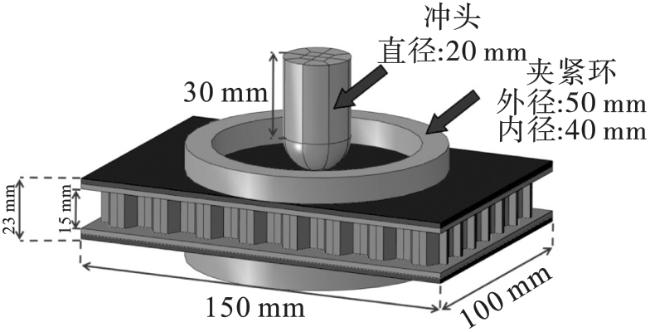
夹层板的高度为23 mm,聚丙烯蜂窝芯的厚度为15 mm。外面板是16层的CFRP30-31,单层厚度为0.125 mm,堆叠顺序为[0;45;-45;90]S2,CFRP的各项参数与文献[1]一致。实验用夹芯板的尺寸为150 mm×100 mm(ASTM D7136标准)。
本次数值研究在分析中也设置了与文献[1]相同的边界条件和数据输出。在ABAQUS软件上进行了显式非线性数值分析。将聚丙烯蜂窝芯与聚丙烯面板的连接方式设置为绑定32,聚丙烯面板和CFRP面板的连接方式也设置为绑定,厚度均为2 mm,冲头质量为5.3 kg,速度为2 747.21 mm/s,模拟20 J能量的低速冲击。
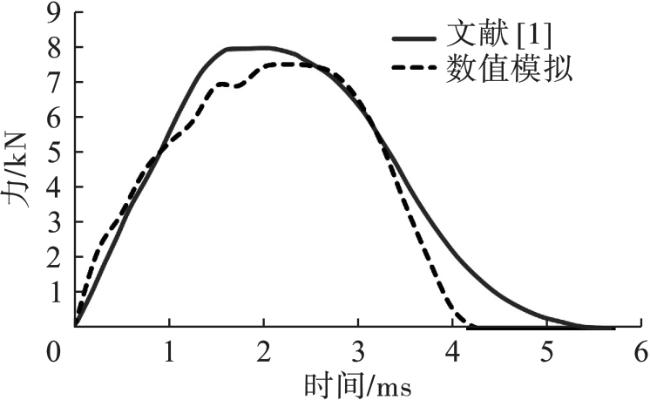
图1为数值模拟的力-时间曲线与文献[1]实验结果的对比图。由图1可知,低速冲击实验曲线的峰值力为8.10 kN,数值模拟曲线的峰值力为7.54 kN,预测接触力峰值与实验值的差异为6.9%。数值模拟的结果与实验结果误差较小,而且趋势较为符合,证明本文的数值模拟结果较为可靠。因此,本文的数值模拟方法和材料模型具有较高的精度,可用于进一步研究带聚氨酯涂层的复合材料夹芯板在低速冲击下的力学性能。
图1 数值模拟的力-时间曲线与文献[1]实验结果的对比图
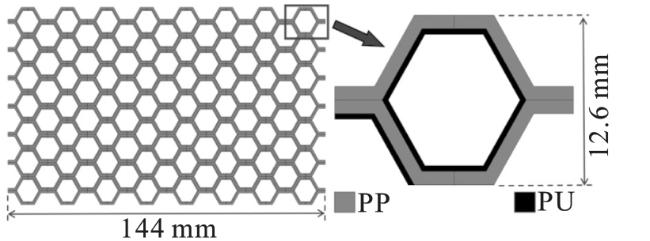
图2为蜂窝芯微观结构的几何参数,聚氨酯涂层以绑定的方式将自身与聚丙烯蜂窝芯的内壁粘在一起,而且涂层厚度均匀。由于目前研究的涂层较薄,所以忽略了涂层的脱黏问题。图3为低速冲击模型的结构,主要由蜂窝板、夹紧环和冲头组成,其他边界条件和尺寸参数设置与上文叙述一致。表2为聚氨酯涂层的材料参数33
图2 蜂窝芯微观结构的几何参数
图3 低速冲击模型的结构
表2 聚氨酯涂层的材料参数
参数 数值
杨氏模量/MPa 905
密度/(kg·m-3 1 050
泊松比 0.49
为了综合评估夹芯板蜂窝芯内壁加涂层在冲击响应方面的影响,将由聚丙烯芯和碳纤维增强树脂基复合材料蒙皮组成的无涂层蜂窝夹芯板与蜂窝芯内壁带有不同厚度聚氨酯涂层的蜂窝夹芯板进行比较,共设置了0.1、0.2、0.3、0.4、0.5 mm 5种涂层厚度,探究聚氨酯涂层厚度对复合材料蜂窝夹芯板抗冲击性能的影响。

2 结果与分析

2.1 能量吸收
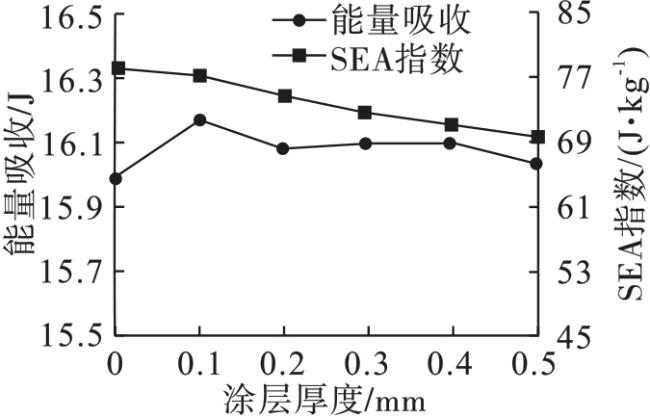
比能吸收(specific energy absorption,SEA)指数是将蜂窝板质量的影响也考虑在内25,在式(1)中定义,m代表试件的质量。通过比较不同涂层厚度蜂窝夹芯板的SEA指数,可以看出明显差异。如图4所示,随着涂层厚度的增加,其SEA指数减小。具体来说,无涂层蜂窝夹芯板的SEA指数比涂层厚度为0.5 mm的蜂窝夹芯板SEA指数高了12.39%。蜂窝芯内壁上的涂层厚度每增加0.1 mm,SEA指数平均下降2.48%,这说明蜂窝芯内壁的涂层厚度对蜂窝夹芯板的能量吸收能力影响较小。
S E A = E A m
图4 不同涂层厚度试件的能量吸收和SEA指数

2.2 蜂窝夹芯板面外位移和蜂窝芯位移

图5为不同涂层厚度试件受到低速冲击后的变形位移。
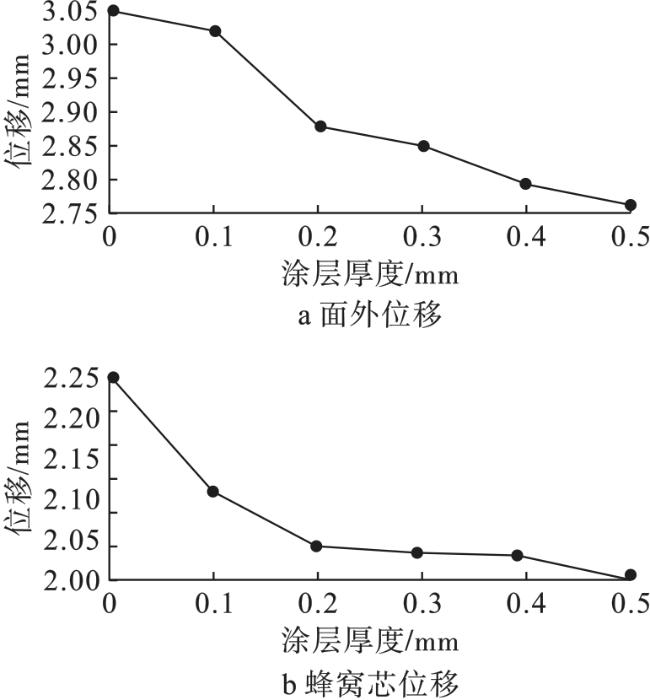
图5 不同涂层厚度试件受到低速冲击后的变形位移
图5可知,夹芯板受到低速冲击后的面外位移和蜂窝芯位移随着蜂窝芯内壁涂层厚度的增加而减小。涂层厚度为0.5 mm蜂窝夹芯板的面外位移比无涂层蜂窝夹芯板的面外位移减小了9.5%。涂层厚度为0.5 mm蜂窝夹芯板的蜂窝芯位移比无涂层蜂窝夹芯板的蜂窝芯位移减小了11.11%。
文献[1]在蜂窝芯壁厚增加0.5 mm的情况下,蜂窝芯位移减少了6.57%。本文在蜂窝芯壁涂覆0.5 mm厚聚氨酯涂层的情况下,蜂窝芯位移减少了11.11%。除此之外,本文与文献[1]的力-时间和力-位移曲线趋势一致,且本文对于蜂窝芯抗冲击能力的提升优于文献[1],因此可以证明数值模拟结果较为合理。

2.3 面板变形

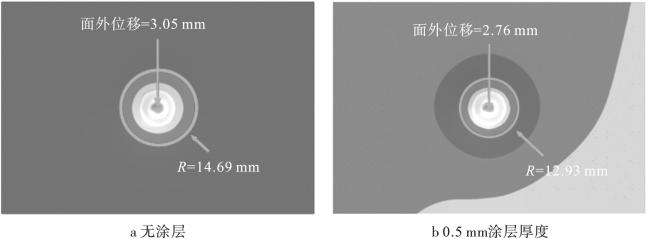
图6为上面板变形分布图,其进一步证实了复合材料蜂窝芯引入涂层的效果,其中介绍了无涂层结构和0.5 mm涂层厚度结构的面外凹陷深度和凹陷最大直径。通过图6可以看出,与无涂层结构相比,加涂层的蜂窝结构中的整个冲击区域明显变小。涂层厚度为0.5 mm蜂窝夹芯板凹陷区域的最大直径比无涂层蜂窝夹芯板凹陷区域的最大直径减小了11.98%。蜂窝芯内壁的涂层厚度每增加0.1 mm,蜂窝夹芯板的凹陷区域的最大直径平均下降2.4%。这证明在蜂窝芯内壁涂上一定厚度的聚氨酯不仅能降低蜂窝芯的损伤程度,也能减小面板的损伤面积,即同时增强了蜂窝夹芯板最重要的两个部分,进而提升了蜂窝芯整体在低速冲击条件下的抗变形能力。
图6 上面板变形分布图
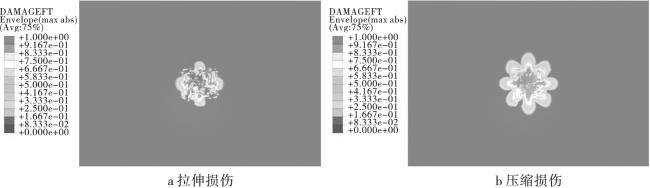
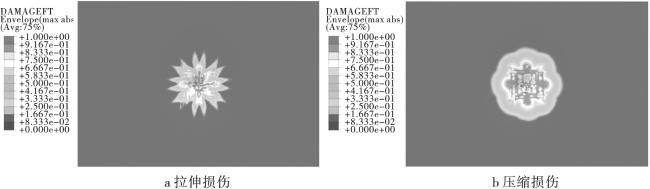
图7图8分别为0.5 mm涂层厚度蜂窝夹芯板的纤维损伤和基体损伤。蜂窝芯的高度使其能在顶部蒙皮和部分蜂窝芯的偏转和损伤中抵消冲击。
图7 0.5 mm涂层厚度蜂窝夹芯板的纤维损伤
图8 0.5 mm涂层厚度蜂窝夹芯板的基体损伤

2.4 力随时间的变化

无涂层和0.5 mm涂层厚度蜂窝夹芯板的力-时间曲线如图9所示。由图9可知,在冲击发生的0.5 ms内,无涂层和有涂层蜂窝夹芯板之间的刚度差异较小。这是因为在冲头撞击夹芯板时,冲头产生的载荷首先由夹芯板上层的CFRP面板和聚丙烯面板吸收,因此每种蜂窝板在这段时间内吸收载荷的效率基本相同。随后,冲击载荷传递到蜂窝芯,蜂窝芯才开始吸收冲击载荷。由于不同涂层厚度蜂窝芯的刚度不同,蜂窝板的载荷吸收效率在0.5 ms之后出现明显不同。含涂层蜂窝夹芯板的曲线比原来的蜂窝夹芯板的曲线表现出更明显的阻尼行为。在1.8~2.6 ms之间,无涂层和有涂层夹芯板的力-时间曲线都呈水平趋势。这表明冲头加速度的变化比较稳定,没有较大的起伏,证明了蜂窝夹芯板在抗冲击性方面是非常有效和可靠的。
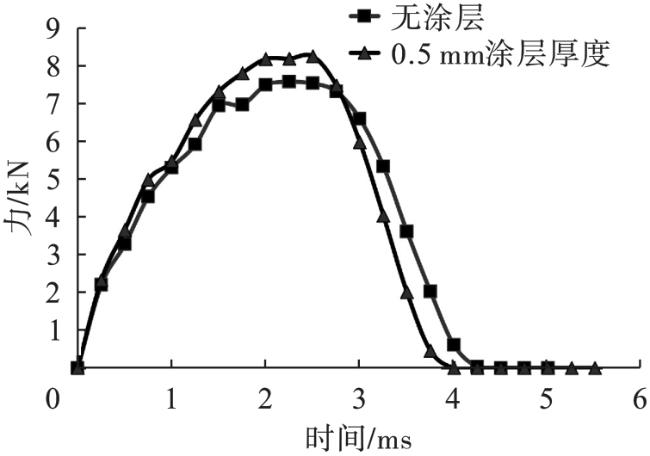
图9 无涂层和0.5mm涂层厚度蜂窝夹芯板的力-时间曲线

3 结论

本文在复合材料蜂窝夹芯板的基础上,提出了一种聚氨酯增强蜂窝芯夹层结构。在前人实验验证的有限元模型的基础上,对蜂窝芯涂覆聚氨酯涂层的复合材料蜂窝夹芯板模型进行低速冲击数值模拟,探讨了蜂窝芯内壁不同厚度的涂层对蜂窝板抗冲击性能的影响。所得结论如下:
1)0.5 mm涂层厚度蜂窝夹芯板的比能吸收指数比无涂层蜂窝夹芯板的比能吸收指数低了12.39%。这说明蜂窝芯内壁的涂层厚度对蜂窝夹芯板的吸收冲击能量的限度影响较小。
2)0.5 mm涂层厚度蜂窝夹芯板的面外位移比无涂层蜂窝夹芯板的面外位移减小了9.5%,蜂窝芯位移减小了11.11%,凹陷区域的最大直径减小了11.98%。聚氨酯涂层通过提高蜂窝夹层结构整体的硬度和增加蜂窝芯内壁的厚度,进而提升了蜂窝夹层结构的抗冲击能力。
3)通过力-时间曲线所表示的在吸收能量和阻尼反作用力方面,与无涂层的蜂窝夹芯结构相比,有涂层的结构具有更高的刚性。
[1]
Acanfora V Zarrelli M Riccio A.Experimental and numerical assessment of the impact behaviour of a composite sandwich panel with a polymeric honeycomb core[J].International Journal of Impact Engineering2023171:104392.

[2]
Wowk D Reyno T Yeung R,et al.An experimental and numerical investigation of core damage size in honeycomb sandwich panels subject to low-velocity impact[J].Composite Structures2020254:112739.

[3]
Dai X J Yuan T Y Zu Z,et al.Experimental investigation on the response and residual compressive property of honeycomb sandwich structures under single and repeated low velocity impacts[J].Materials Today Communications202025:101309.

[4]
Su M M Ma Q X Zhang A,et al.Mechanical pro-perties of sandwich structures with different webs enhanced by filling polyurethane foam and enca-sing rectangular tube[J].Materials Today Communications202440:110058.

[5]
Chen Y L Jin Z Y Kang W B,et al.3D printed bio-inspired self-similar carbon fiber reinforced composite sandwich structures for energy absorption[J].Composites Science and Technology2024248:110453.

[6]
Sukia I Esnaola A Erice B,et al.Impact behaviour of bio-inspired sandwich panels integrally manufactured from 3D printed continuous carbon fibre reinforced polyamide[J].Composites Science and Technology2024250:110515.

[7]
Li Q W Sun B H.Numerical analysis of low-speed impact response of sandwich panels with bio-inspired diagonal-enhanced square honeycomb core[J].International Journal of Impact Enginee-ring2023173:104430.

[8]
Song S J Xiong C Yin J H,et al.Flexural beha-vior,failure analysis,and optimization design of a hybrid composite Kagome honeycomb sandwich structure[J].Thin-Walled Structures2023187:110743.

[9]
Shi S S Cheng G Chen B Z,et al.Effect of an S-shaped reinforced core on the compression properties of composite honeycomb sandwich panel and tube structures[J].Thin-Walled Structures2023187:110732.

[10]
Chen Y Zeng X Z Deng Y F,et al.Investigation on manufacturing and low-velocity impact performance of all-composite sandwich structure with S-type foldcore[J].Composite Structures2022290:115539.

[11]
Zhu X J Xiong C Yin J H,et al.Experimental study and modeling analysis of planar compression of composite corrugated,lattice and honeycomb sandwich plates[J].Composite Structures2023308:116690.

[12]
Zhang C Fang X Curiel-Sosa J L,et al.Damage in hybrid corrugated core sandwich structures under high velocity hail ice impact:a numerical study[J].Defence Technology202327:217-236.

[13]
Li Z J Wen Y F Wen X L,et al.Single and double-layered kirigami corrugated sandwich pa-nels against impact loads[J].Structures202351:402-414.

[14]
Zhang Y Cai D A Peng J F,et al.On low-velocity impact behavior of sandwich composites with negative Poisson’s ratio lattice cores[J].Compo-site Structures2022299:116078.

[15]
Wang Z G Wang X X Liu K,et al.Crashworthiness index of honeycomb sandwich structures under low-speed oblique impact[J].International Journal of Mechanical Sciences2021208:106683.

[16]
Zhu K Y Zheng X T Zhang C,et al.The behavior of interlocked ortho-grid composite sandwich structure subjected to low-velocity impact[J].Composite Structures2023304:116399.

[17]
Lv H Y Shi S S Chen B Z,et al.Low-velocity impact response of composite sandwich structure with grid-honeycomb hybrid core[J].International Journal of Mechanical Sciences2023246:108149.

[18]
Flora F Boccaccio M Pinto F,et al.A bistable impact resistant sandwich carbon-fibre reinforced core[J].Composite Structures2024331:117865.

[19]
Al A A Arhore E Ghasemnejad H,et al.Experimental and numerical investigation of multi-layered honeycomb sandwich composites for impact mechanics applications[J].Results in Engineering202421:101817.

[20]
Xue X W Zhang C F Chen W,et al.Study on the impact resistance of honeycomb sandwich structures under low-velocity/heavy mass[J].Compo-site Structures2019226:111223.

[21]
Çelik M Güden M Sarıkaya M,et al.The impact response of a Nomex honeycomb core/E-glass/epoxy composite sandwich structure to increasing velocities:experimental and numerical analysis[J].Composite Structures2023320:117205.

[22]
Qin Q H Chen S J Bai C Y,et al.On influence of face sheet distributions on low-velocity impact failure of metal honeycomb core sandwich plates[J].Thin-Walled Structures2023182:110202.

[23]
He Q Li L Z Jing X W,et al.Impact resistance analysis and multi-objective optimization of polyurea-coated auxetic honeycomb sandwich pa-nels[J].Materials Today Communications202335:105577.

[24]
Abbasi S Umer M A Irfan M,et al.Enhanced mechanical properties of surface modified and silica reinforced nomex sandwich composites[J].Mate-rials Today Communications202336:106346.

[25]
Huo X T Sun G Y Zhang H Y,et al.Experimental study on low-velocity impact responses and residual properties of composite sandwiches with metallic foam core[J].Composite Structures2019223:110835.

[26]
Acanfora V Sellitto A Russo A, et al.Experimental investigation on 3D printed lightweight sandwich structures for energy absorption aerospace applications[J].Aerospace Science and Tech-nology2023137:108276.

[27]
Di Caprio F Sellitto A Riccio A,et al.Experimental and numerical study of composite omega stringer-skin debonding under flexural loading conditions[J].Multiscale and Multidisciplinary Modeling,Experiments and Design20192(2):105-118.

[28]
Riccio A De Luca A Di Felice G,et al.Modelling the simulation of impact induced damage onset and evolution in composites[J].Composites Part B:Engineering201466:340-347.

[29]
Burlayenko V N Sadowski T.Influence of skin/core debonding on free vibration behavior of foam and honeycomb cored sandwich plates[J].International Journal of Non-Linear Mechanics201045(10):959-968.

[30]
Acanfora V Castaldo R Riccio A.On the effects of core microstructure on energy absorbing capabilities of sandwich panels intended for additive manufacturing[J].Materials202215(4):1291.

[31]
Bragagnolo G Crocombe A D Ogin S L,et al.Investigation of skin-core debonding in sandwich structures with foam cores[J].Materials & Design2020186:108312.

[32]
Acanfora V Saputo S Russo A,et al.A feasibility study on additive manufactured hybrid metal/composite shock absorbers[J].Composite Structures2021268:113958.

[33]
霍俊芳,李海青,郝贠洪,等.钢结构聚氨酯涂层力学性能及抗冲击性能的有限元分析[J].腐蚀与防护202243(8):80-85.

Outlines

/